

Buying heavy-duty castor wheels with the right load rating and tread material is only half the equation. How you combine swivel castors and rigid (fixed) castors beneath a trolley, cage, or mobile machine determines whether your equipment tracks smoothly down a 50-meter warehouse aisle or fishtails uncontrollably into racking and walls.
Across distribution warehouses along Mombasa Road, manufacturing plants in Ruiru and Athi River, hospital corridors, and supermarket stockrooms, poor wheel configurations cause unnecessary operator strain, slow down order picking, and shorten wheel life. Understanding the mechanical difference between swivel and rigid castors—and matching the right layout to your floor plan—makes material handling noticeably safer and faster.
Swivel vs. Rigid Castors: How Each Works
1. Rigid (Fixed) Castors
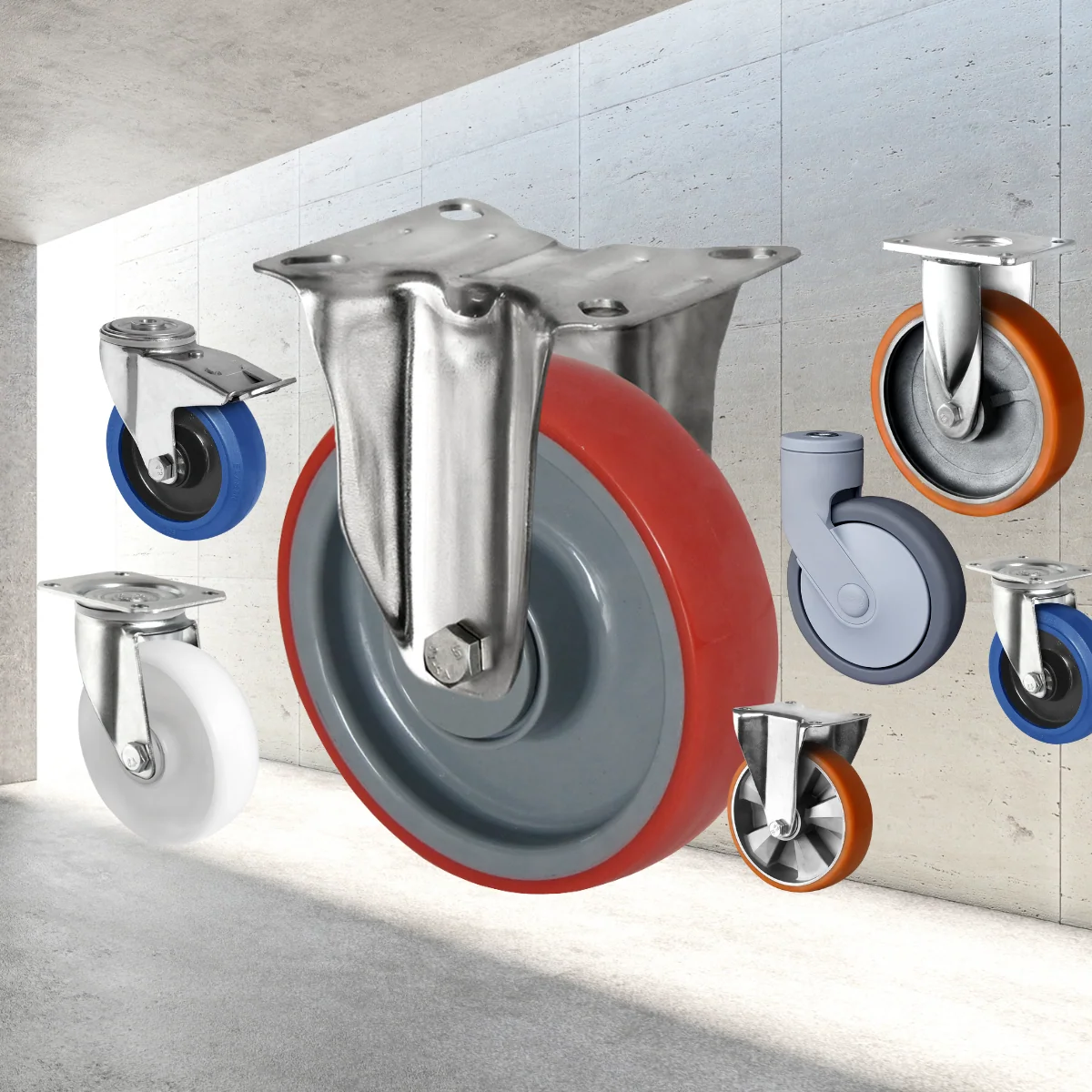
A rigid castor has a stationary fork welded or bolted directly to the mounting plate, restricting the wheel to rolling forward and backward in a single straight line.
- Strengths: Provides directional stability, tracks straight over long distances, carries slightly higher shock loads because there is no rotating ball raceway to absorb side impacts, and costs less than a matching swivel unit.
- Limitations: Cannot turn on its own; requires swivel castors elsewhere on the cart to steer.
2. Swivel Castors
A swivel castor features a 360-degree rotating ball-bearing raceway between the mounting plate and the wheel fork, paired with a deliberate horizontal offset (called swivel lead or offset). That offset forces the wheel to trail smoothly behind the pivot point whenever the operator changes direction.
- Strengths: Enables tight cornering, sideways movement, and effortless maneuverability in cramped aisles or elevators.
- Limitations: Without rigid wheels to anchor direction, a cart fitted exclusively with swivel castors tends to drift sideways on sloped loading docks or wander back and forth when pushed quickly down long aisles.
The 5 Most Effective Castor Wheel Layouts (And Where to Use Them)
Layout 1: 2 Swivel + 2 Rigid (The Warehouse Standard)
This classic four-wheel configuration places two rigid castors at one end and two swivel castors at the opposite end.
- Best For: Standard warehouse platform trolleys, supermarket stock carts, roll cages, and long-corridor transport.
- Pro Tip on Placement: Mount the swivel castors at the handle (push) end when navigating tight corners and doors, or place rigid castors at the rear when pushing heavy loads straight down long, narrow aisles.
- Pros: Tracks straight effortlessly, steers predictably, and offers the best balance of cost and load stability.
Layout 2: 4 Swivel Castors (Maximum Maneuverability)
All four corners use 360-degree swivel castors (often fitted with total-lock brakes on at least two diagonally opposite wheels).
- Best For: Tight hospital wards, commercial kitchens, bakery cooling racks, retail aisles, and mobile workshop tables that must slide sideways into tight spaces or spin in place.
- Watch Out: Difficult to steer in a straight line over long warehouse runs or across sloped ramps unless equipped with directional locks (a pin mechanism that temporarily locks two swivel heads into rigid mode).
Layout 3: 4 Swivel + 2 Center Rigid (The 6-Wheel Diamond / Tilt-Cart Setup)
Commonly used on heavy-duty supermarket U-boat carts, airport luggage trolleys, and long distribution cages, this layout puts two slightly larger rigid wheels in the center and four swivel castors at the four corners.
- Best For: Long narrow carts operating in tight retail or warehouse aisles where zero-radius turning is essential.
- How It Works: Because the center rigid wheels sit slightly lower than the corner swivel castors (creating a subtle rocking pivot), the cart spins 360 degrees within its own length while still tracking straight down aisles under heavy loads.
Layout 4: 2 Rigid + 1 Swivel (Three-Wheel Tripod Layout)
Frequently found on triangular drum dollies, gas cylinder trolleys, and compact bucket carts.
- Best For: Round loads (such as 200-liter oil or chemical drums) on smooth, level factory floors.
- Watch Out: Less lateral tipping stability on uneven surfaces or ramps compared to four-wheel carts.
Layout 5: Diamond Pattern (2 Center Rigid + 1 Front Swivel + 1 Rear Swivel)
In this four-wheel diamond arrangement, two rigid castors carry the primary weight in the middle, while single swivel castors at the front and back guide steering.
- Best For: Long, narrow material-handling carts operating on flat warehouse floors that need tight turning circles without the cost of six wheels.
- Watch Out: Never use on high-center-of-gravity loads or uneven outdoor cabro yards, as missing corner wheels reduce side-to-side stability.
Quick Selection Guide by Application
| Facility / Equipment Type | Recommended Layout | Brake Recommendation |
| Warehouse Platform Trolley | 2 Swivel + 2 Rigid | Total-lock brakes on both swivel castors |
| Hospital Bed / Medical Cart | 4 Swivel (with directional lock) | Total-lock or central-locking brakes |
| Commercial Kitchen / Bakery Rack | 4 Swivel | 2 diagonally opposed total-lock brakes |
| Supermarket U-Boat / Narrow Aisle Cart | 4 Swivel + 2 Center Rigid | Foot-operated floor lock or swivel brakes |
| Mobile Heavy Workbench / Generator | 4 Swivel (heavy-duty) | Total-lock brakes on all 4 wheels |
3 Practical Installation Tips for Smooth Performance
- Match Overall Mounting Height: When pairing swivel and rigid castors on the same trolley, always buy matching models from the same series so their overall installed height is identical—even a 3mm height difference causes annoying cart wobble.
- Place Brakes Where Operators Can Reach Them: Install total-lock brake castors on the handle end of trolleys so staff don’t have to reach underneath heavy cargo to engage or release foot pedals.
- Lubricate Swivel Raceways Periodically: In dusty warehouses or wet washdown areas, apply grease through the swivel zerk fitting every few months so swivel heads rotate freely without binding.